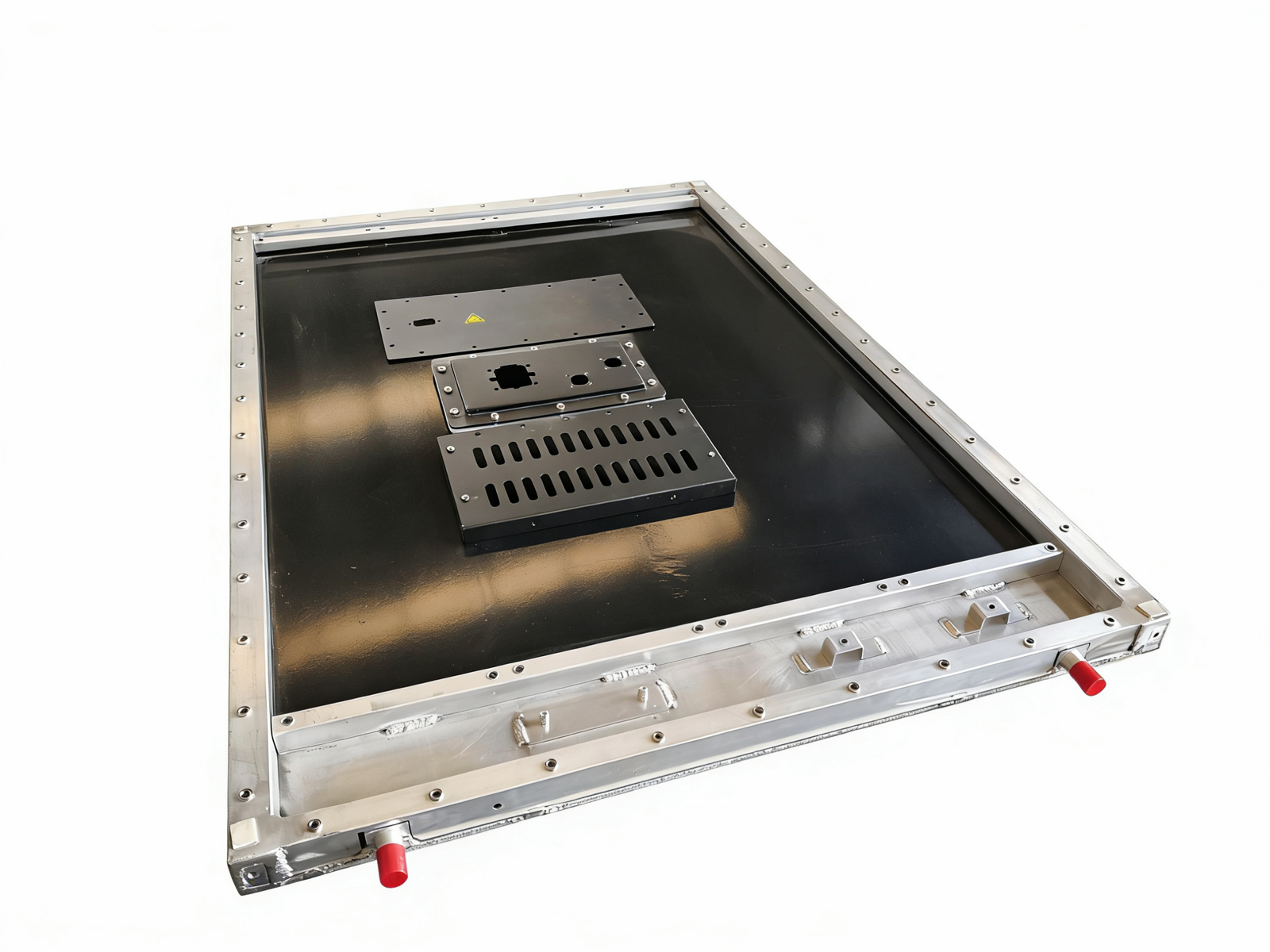
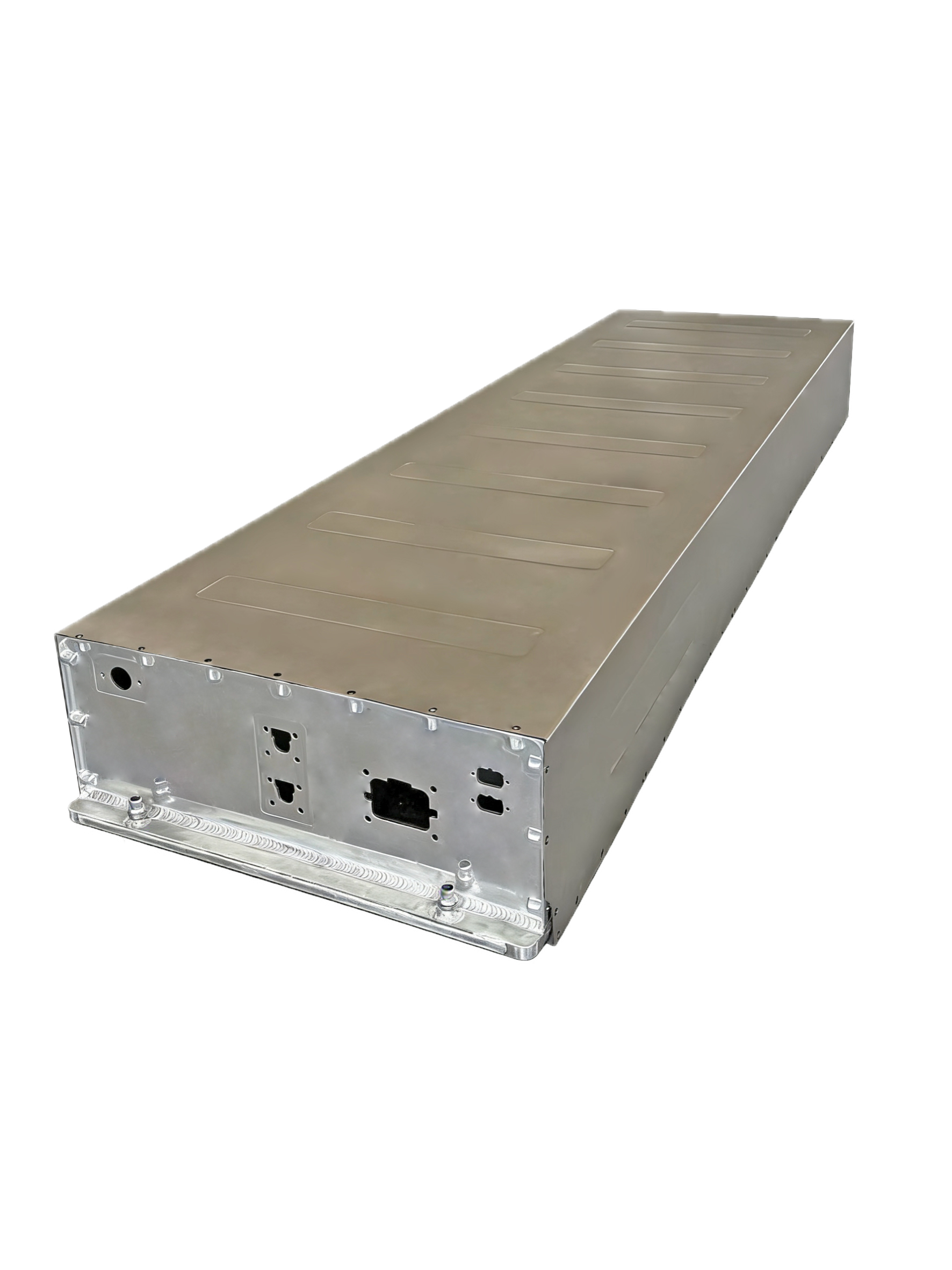
Liquid cold plates sit between battery cells and the cooling circuit. They have to do three things at once — transfer heat efficiently, never leak coolant, and survive a decade of vibration and thermal cycling. The single biggest variable in whether a cold plate succeeds at all three is how the aluminum sheets are joined.
Most commercial vehicle cold plates today still use brazing — a process where molten filler metal flows between two aluminum surfaces above 600°C, then cools to form a bond. It's cheap, well-understood, and good enough for many applications. But for high-cycle commercial EV batteries — heavy trucks, mining vehicles, energy storage doing 1–2 cycles per day — brazing's limitations show up quickly. Friction stir welding (FSW) is the alternative gaining ground, and the performance differences are not subtle.
Why joint method matters more than people realize
A cold plate is essentially two aluminum panels sandwiched together with a coolant flow channel between them. The joint between the panels is the single point of failure for the entire pack's thermal management.
When the joint fails: coolant leaks into the battery enclosure (catastrophic event), pressure drop changes throw off the entire flow circuit, and hot spots develop at the failure site, creating thermal-runaway risk.
Joint quality also drives temperature uniformity across the pack. A pack with ±1°C cell-to-cell ΔT can lose 30–40% less capacity over its life than one with ±5°C — and the cold plate joint geometry is what creates uniform flow.
What brazing actually does
Brazing for aluminum cold plates uses an Al-Si filler alloy (typically 4045 or 4343) sandwiched between the two aluminum panels and run through a controlled-atmosphere brazing furnace at 600–615°C. The filler melts, flows by capillary action into the joint gap, and solidifies as the assembly cools.
Done well, brazing produces strong joints at low cost. The challenges:
•Heat-affected zone weakening — 600°C is well above the precipitation-hardening temperature of 6000-series aluminum (typical battery enclosure material). Mechanical strength of the parent metal drops by 30–40% in the heat-affected zone.
•Filler metal porosity — trapped flux gas creates microvoids in the joint. These don't cause immediate leaks but become fatigue nucleation sites.
•Thermal distortion — the entire assembly heats and cools together. Large cold plates over 1 meter deform unpredictably, requiring post-braze flatness correction.
•Yield rate — typical industry yield for medium-complexity battery cold plates is 92–95% pre-rework.
For consumer EVs doing 1 cycle per day in mild climates, none of this matters much. For heavy commercial EVs, mining trucks, or stationary ESS doing 2–3 deep cycles daily for 10+ years, fatigue life becomes the dominant concern.
How friction stir welding works
FSW doesn't melt the aluminum. A non-consumable rotating tool (typically tool steel or tungsten carbide) is plunged into the joint between two abutting aluminum panels and traversed along the seam. Friction between the tool and aluminum heats the metal to roughly 80% of melting point — soft enough to extrude and stir, but never liquid. The shoulder of the tool consolidates the stirred metal behind it, leaving a fully bonded, fully solid joint.
The result is a joint structurally indistinguishable from the parent metal. No heat-affected zone weakening. No porosity. No filler metal contamination. No thermal distortion of the surrounding plate.
For a 1-meter battery cold plate after 10 years of thermal cycling: typical brazed joint leak rate is 1–3% of units; typical FSW joint leak rate is under 0.1%. These numbers come from accelerated life testing — 1000 cycles between -40°C and +85°C with 5 bar pressure pulses. The 30× improvement in long-term leak rate is the headline that makes FSW worth the capital cost for commercial-vehicle and energy-storage customers.
What FSW costs
The honest tradeoffs:
•Capital equipment — a single dedicated FSW machine for battery-pack-scale cold plates costs $400,000–$1,200,000. Brazing furnaces of equivalent throughput run $200,000–$600,000.
•Cycle time — FSW is currently 2–3× slower per joint than brazing for high-volume parts. This is closing as machine designs improve.
•Tool wear — FSW tools wear out and must be replaced every 5,000–15,000 meters of weld depending on alloy. Brazing has no equivalent consumable.
•Design constraints — FSW requires backing material behind the joint and a clear top approach. Some complex 3D cold plate geometries are not FSW-able.
For commercial vehicle and energy storage applications, the capital cost is amortized across long part runs and the leak-rate advantage easily justifies it. For low-volume specialty applications, brazing remains rational.
What to verify when sourcing FSW cold plates
Not every vendor that says "FSW" actually does FSW well. Things to ask:
1. What's your machine count and which models?
Real FSW production runs on dedicated FSW machines, not retrofitted CNC mills. Names to look for: ESAB FSW, MTS, Bond Technologies, China's Dahenergy DH-FSW series. Model numbers indicate weld depth capability — the DH-FSW-1825A handles up to 25mm thickness.
2. What's your in-process leak test?
Production-line air-decay testing at 5+ bar with sub-ppm sensitivity. Vendors that test offline by sample don't catch defects.
3. What's your traceability?
Each cold plate should link to its FSW machine, tool serial, parameter set, and operator. Required for IATF 16949 — also a tell for vendor maturity.
4. What's your post-FSW dimensional control?
FSW doesn't distort the surrounding plate but production consistency matters. Look for in-line flatness scanning, not post-batch sample inspection.
5. What's your accelerated-life-test data?
Reputable vendors will share ALT results from independent labs (TÜV Rheinland, SGS).
Where this fits in OEM sourcing
For commercial EV truck OEMs, the supplier qualification flow is initial PPAP submission with samples, then lab testing including thermal and pressure cycling, then field trial in pre-production trucks, then volume ramp. FSW vendors typically clear PPAP faster than brazed vendors because the joint quality data is consistent across batches. Field trials show the same — fewer warranty claims trace to FSW joints than brazed ones.
For energy storage system integrators, the calculation is similar but driven by total cost of ownership over 15–20 year project lives. Owners have learned the hard way that cold plate failures dominate ESS warranty cost. Specifying FSW cold plates upfront — even at higher unit cost — pays back inside the first 5 years for utility-scale projects.
Keyuan's FSW capability
For context on what production-scale FSW looks like — Keyuan operates 2 dedicated FSW machines (Dahenergy DH-FSW-1825A) at the Anqiu factory, alongside automated pre-FSW edge preparation, in-line air-decay leak testing at 5 bar, and 100% batch-level traceability tied to our IATF 16949:2016 system. We use FSW for our LCP-1P52S, LCP-1P104S, and LC H/G/C series products. Our published yield is over 99.5% pre-rework with under 0.05% field-return rate across 5 years of production data.
If you're evaluating cold plate suppliers and want to talk specifics — leak data, ALT reports, production process audit — get in touch.